WERS has published a new evidence briefing examining the human impact of the Government's Named Community Sponsorship scheme, drawing on correspondence from people around the world desperately seeking safety.
Imagine being forced to leave your home because of war, persecution or violence. Imagine spending years waiting for help, uncertain whether your family will ever find somewhere safe to rebuild their lives.
Then one day, you hear that the UK Government has announced a new route for refugees to come to Britain through community sponsorship.
For many, that announcement brings something they have been holding onto for years: hope.
Following the Government's announcement - we - a small charity based in Newcastle upon Tyne, began receiving emails from people across the world asking whether we could help them reach safety.
The messages came from Sudan, Afghanistan, Palestine, Yemen, Iran, Bangladesh and other countries. Many described heartbreaking circumstances, including threats to their lives, financial hardship, separation from loved ones and years spent waiting for answers.
One father wrote:
"Nothing is more painful than being unable to assure our children that tomorrow will be safe."
Another person, who had already spent years waiting for help, simply pleaded:
"Please try to understand my helpless and difficult situation, save my life from this hell in Bangladesh."
These are people looking for an opportunity to live safely, work, contribute to their communities and give their children a future.
And they were turning to WERS, hoping we might have an answer.
But how realistic is that hope?
The Government's new Named Community Sponsorship scheme is intended to allow eligible community organisations to identify and support refugees to resettle in the UK.
However, guidance published on 29 October 2026 revealed significant restrictions.
Initially, the scheme is limited to refugees meeting specific requirements in just seven countries: Bangladesh, India, Pakistan, Malaysia, Egypt, Uganda and Kenya. There are also strict registration, eligibility and sponsorship requirements.
This means that many of the people contacting us, including those living in some of the world's most dangerous circumstances, cannot access the scheme in its initial form.
For others, important questions remain unanswered. How do they find a sponsor? Who can help them understand whether they qualify? What happens if they have no connections to anyone in the UK?
And who is responsible for answering these questions?
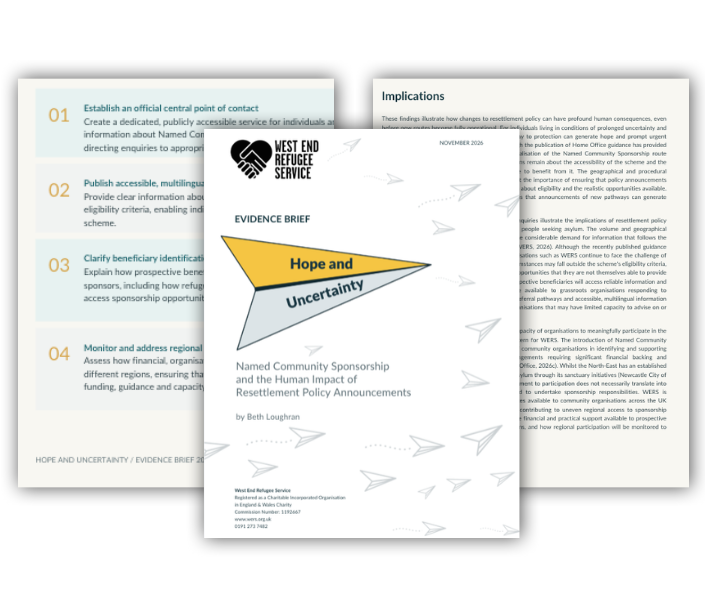
With the support of volunteer researcher Beth Loughran, WERS has analysed the correspondence we received and published a new evidence briefing, Hope and Uncertainty: Named Community Sponsorship and the Human Impact of Resettlement Policy Announcements.
The report highlights the gap between the expectations created by announcements of new routes to safety and the practical reality facing those trying to access them.
It also raises concerns about the responsibilities being placed on community organisations.
Charities like WERS want to help. But we do not have the resources or authority to arrange international resettlement, and we cannot provide answers that the Government has not made available.
There is also a risk that communities with greater financial resources will be better placed to participate in sponsorship, leaving smaller organisations and less affluent regions at a disadvantage.
What are we asking the Government to do?
Our recommendations are straightforward.
We are asking the Home Office to establish a central point of contact where refugees and organisations can obtain reliable information, publish clear guidance in different languages, explain how refugees can be identified and matched with sponsors, and ensure that smaller community organisations across the country have the support needed to participate.
We also want greater clarity about how people without existing connections in the UK can access sponsorship opportunities.
These are practical steps that could make an important difference.